Talent will get you in the door. It will not guarantee that you’ll ever get beyond the foyer.
And you still might find yourself tossed back onto the porch.
O.C. Smith grew up in Louisiana, Arkansas, and California, then joined the Air Force in 1951, basically straight out of high school, but he knew from a young age he wanted the life of a singer, so he entered (and won) talent contests while still in the service, and then toured with a couple of jazz big band leaders after his discharge in 1955. He definitely had skills — Count Basie hired him as lead singer for three years in the early 1960’s — but unfortunately, Smith’s solo career stalled at the starting line.
Cadence Records released O.C.’s first single in 1956. Flop. Three subsequent releases brought the same results, so Cadence let him go and he signed with MGM. Once again, flippity floppity. This pattern continued for over a decade with half a dozen smaller labels, so it’s a good thing he was in demand as a big band vocalist or Smith would have found it necessary to go back to school, or rejoin the Air Force, or take an office job in a cubicle with a cat poster captioned “Hang In There”. . . *shudder*
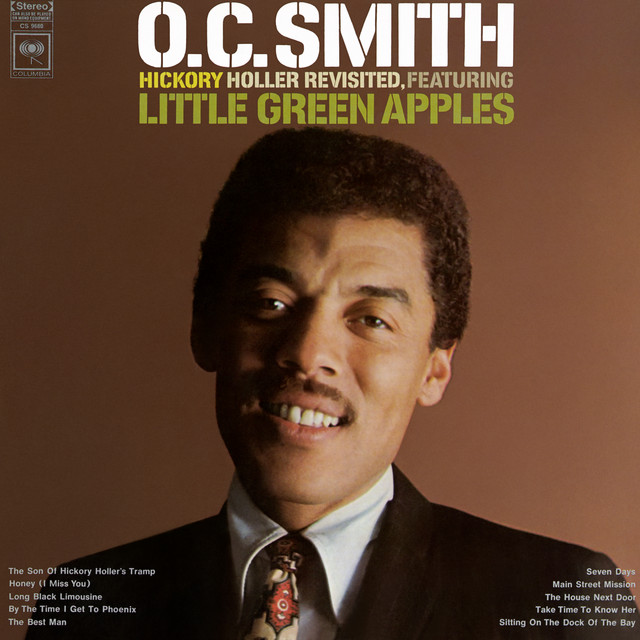
In 1968, Smith’s latest record company, Columbia, was preparing to show him out the door when he suddenly scored a hit out of nowhere. “The Son Of Hickory Holler’s Tramp” only made it to #40 on the US chart (not great, although still a massive improvement), but for some reason it exploded in the UK, topping out at #2, just behind Louis Armstrong’s “What A Wonderful World.” That got Columbia’s attention, but then the follow-up failed and O.C. was half in and half out when he received a helping hand from a DJ in Detroit.
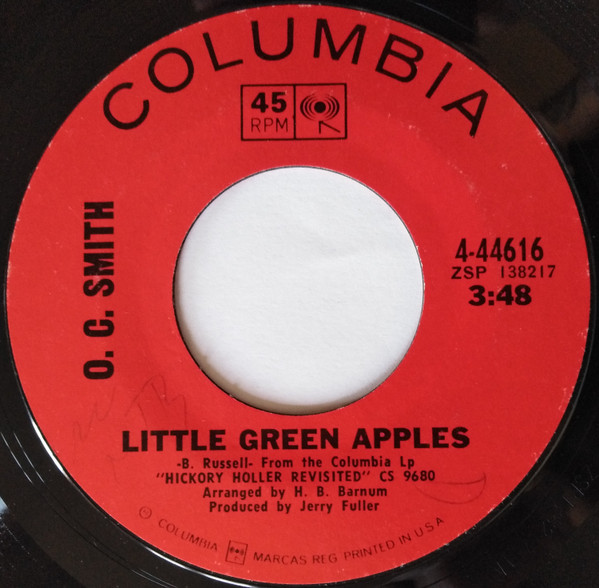
It seems this DJ had checked out the rest of Smith’s full-length album and decided of his own accord to play a track for his listeners called “Little Green Apples.” The phone lines immediately exploded. The DJ contacted Columbia to inform them of this phenomenon and the label rushed to release the song as Smith’s next single.
“Little Green Apples” shot up the US charts to #2, blocked from the top spot only by the juggernaut that was “Hey Jude” by The Beatles. Smith closed the door behind him (remember the door?), went into the living room, sat on the couch and made himself at home. He was here to stay.
So grab your Dr. Seuss and Mother Goose, and stumble to the breakfast table . . . with O.C. Smith.
If you were listening exclusively to country stations at the time, you would know “Little Green Apples” as a big hit in 1968 (on the Country chart) by Roger Miller, for whom the song was written:
 1 2 3 o' clock 4 o' clock Rock