Some are born to fame, and others have fame thrust upon them.
There wasn’t a lot of entertainment for children in post-World War II England. No TV, no computers, no video games. Just lots of musty old books, overplayed board games, and leftover bomb craters. Kids actively had to search for things to do while their parents busily rebuilt the nation and scrounged for sugar. Luckily, almost every household contained one useful item towards this purpose: a piano. Large family gatherings occurred frequently, with parents, siblings, aunts, uncles and cousins entertaining themselves around the old Joanna with singalongs and general merriment.
Partly out of boredom, young Clive Powell found himself learning to play, and playing a lot. (If you’re going to put in your 10,000 hours to achieve mastery of something, it’s best to start early.) As a teen he was already backing up American rock and rollers like Gene Vincent and Eddie Cochran when they toured London, soaking up invaluable experience and advice from the grizzled veterans. Musical impresario Larry Parnes — infamous for rebranding his charges with showbiz names like Tommy Steele, Duffy Power, and Vince Eager — signed him up, and upon discovering Clive could sing as well as play the piano, dubbed him Georgie Fame.

Georgie eventually ended up with his own band, The Blue Flames, and the combo spent three years in smoke-filled, sweaty clubs playing a mix of organ-driven R&B, bluebeat, pop jazz, and rock & roll. Unfortunately, while popular in clubs, Georgie couldn’t get his songs played on the very narrow-minded and strict BBC radio, so his manager, a very shrewd and enterprising young man by the name of Ronan O’Rahilly, circumvented the BBC by starting his own pirate radio station. On a ship. Where else would pirates be?
Broadcasting from international waters, Radio Caroline technically wasn’t breaking British law, and they played all the cutting edge music the mod kids wanted to hear and the stodgy BBC ignored. Including Georgie Fame and The Blue Flames.
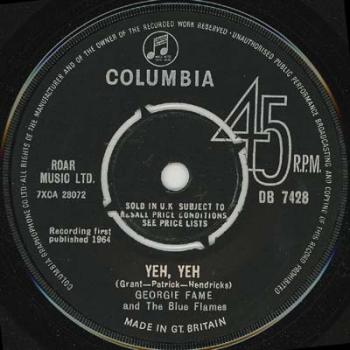
After his first three singles failed to make any impression, Georgie and the band’s fourth single, “Yeh Yeh,” released at the end of 1964, shot straight to #1 on the UK charts. The song actually began as an instrumental by Afro-Cuban conga drummer Mongo Santamaría, who first recorded it in 1963; later that year jazz vocalist Jon Hendricks wrote lyrics for the tune which he and his trio played at the Newport Jazz Festival. Georgie got a hold of the song the following year and turned it into a groovin’ nightclub banger, finally achieving what his name promised.
So turn the lights down low and answer in the affirmative …. with Georgie Fame and The Blue Flames.
 1 2 3 o' clock 4 o' clock Rock
His voice has a pleasing timbre!
It does! I’ve had this song on my list to write about since the very beginning but could never figure out what to write. I finally managed it!
I like that you provided the contexts of post-WWII and the BBC vs. pirate radio. There’s a lot of interesting detail in this post – as always!
Oh my, I remember that song! So does Peder. He’s boiling up a brine for making pickles right now, and when he heard this song, he started snapping his fingers. By the way, he listened to pirate radio in Denmark when he was growing up.
I’m glad I could bring back memories! And I’m always happy when a song gets people to snap their fingers and tap their toes. I will still start dancing when I get excited by a song I love. Homemade pickles are a favorite of my wife, Claire, as well!