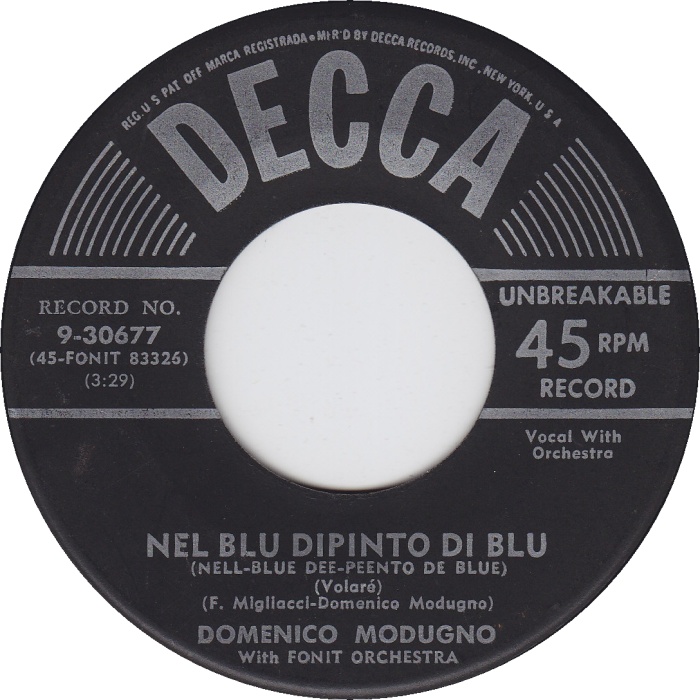
“To sleep, perchance to dream, perchance to pen a hit song. For in that sleep what gold and platinum dreams may come? ‘Tis a #1 devoutly to be wished.” — William Shakespeare
This story begins with Franco Migliacci. He and Domenico Modugno met in acting school in Italy and developed a lasting friendship. Years later, in the summer of 1957, the two planned an afternoon of sailing, but Modugno was running late and, while killing time waiting for his delinquent amico, Migliacci indulged in a bit of the grape, and then a bit more, before falling asleep and experiencing a vivid, vino-fueled dream of flying. He awoke to find himself staring at two Chagall prints: one of a man flying through dark blue air, and a second of a painter who was half-painted blue. Although he had never written anything before, Migliacci suddenly found himself inspired to combine all these dream-painting images into lyrics.
When Modugno finally arrived, all thoughts of sailing were cast aside after Migliacci excitedly relayed his experience and his first attempt at words. Neither was a professional songwriter, so they hammered away at the tune for days, seemingly unable to solve it. But they had a title: “Nel blu, dipinto di blu,” or, “In the blue, painted blue.”

Soon after, during a violent storm one night, the wind blew the shutters open and Modugno, struck by inspiration, started singing “Volare, oh, oh” at the top of his lungs out of the window and into the teeth of the storm. The moneymaker was now in place — this was the hook.
Modugno performed “Nel Blu, Dipinto Di Blu” at the Sanremo Song Festival — one of the longest-running music contests in the world and the model for Eurovision — and proceeded to win. The song took Italy by storm with its chiming organ, harp flourishes, and impassioned vocal, and when released as a single in the US in the summer of 1958, flew straight to #1, quickly becoming the best-selling record of the year. 14 other versions were released almost immediately in its wake, including what has now become probably the most well-known interpretation over the subsequent decades, Dean Martin’s English-Italian blend, known simply as “Volare.” All because of a midsummer flight dream.
Quindi dipingiti di blu e vola viav … with Domenico Modugno.
 1 2 3 o' clock 4 o' clock Rock
This song just has a certain something, you know?
All of the elements do work together well. Various versions show up in movies all the time so it does seem timeless.
Such a lovely tune!
I’ve always enjoyed the various versions of this song, but the original is my favorite. Lovely, indeed!