Nothing inspires like young love. And hormones.
Maurice Williams and a few friends started a gospel group as kids in the early 1950s, and then in high school went a more secular route by switching to the new and hip doo-wop sound. South Carolina wasn’t exactly the entertainment capital of America, so the boys raised money from local businesses to finance a trip to Nashville in 1957 and quickly got themselves a record deal, a studio recording, and a hit R&B single with a song called “Little Darlin'” under the name The Gladiolas. Unfortunately, the song stalled on the national chart, but ended up as a massive #2 hit when covered by Canadian group The Diamonds that same year.
Williams could console himself with songwriting royalties, but he wanted a hit for himself and his longtime friends and bandmates. Back in South Carolina, the group toured where they could and while out on the road, at a repair shop to get their broken down van fixed, they spotted a Ford Zodiac, an imported automobile from the UK. They needed a new name anyway and The Zodiacs sounded unique.

The group knew they also needed songs to get a record deal so they went into a former television studio and recorded a handful of tracks as best they could. Their two producers (slash managers?) took the demos and traveled to New York, where they proceeded to face rejection from every record company in town. Renowned hitmaker Jerry Wexler at Atlantic told them they and their group should get out of the business.
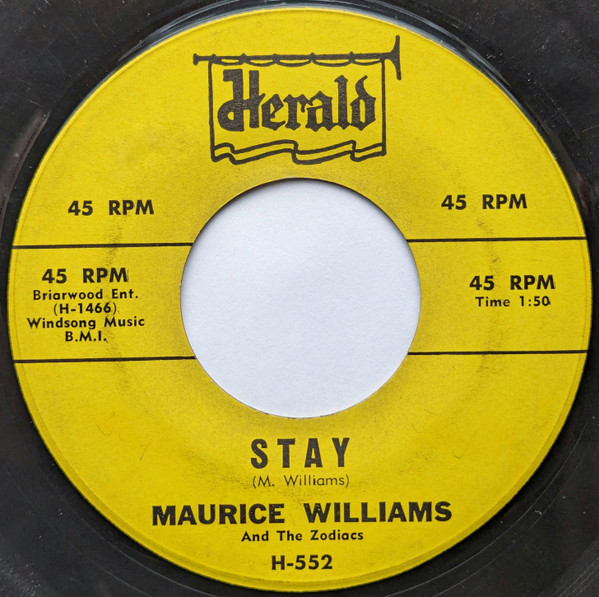
The pair finally caught a break at small indie label Herald Records. The owner picked out a song called “Stay,” but told them he couldn’t release it in its current state because the sound levels were too low. The novice producers didn’t know how to get a better sound so the owner drew a picture of VU meters and explained how the needle needed to reach right up to, but not too far beyond, the red zone.
With this revelatory information in hand, they returned to South Carolina where Maurice Williams and the Zodiacs re-recorded the track. Williams had written “Stay” around 1955, as a teenager, after going on a date with a girl who insisted she couldn’t stay out any later past her curfew. He went home and immediately poured his longing into the lyrics for “Stay.” But he wasn’t sure it was good enough, so he just held on to it.
Finally released in August of 1960, “Stay” wound up topping the charts (one position better than The Diamonds had reached with Williams’ previous song). The single was, and still is, the shortest song to hit #1 on the US Hot 100. And really, imploring should always be brief — anything longer smacks of desperation.
So have another dance — just one more … with Maurice Williams and The Zodiacs.
 1 2 3 o' clock 4 o' clock Rock
Are you and I the only people who remember this song? I’m playing it in my head as I type this. I had that 45 and wore it out. OK, now I’m playing the song and dancing in my chair. What a great way to start my day…I never realized it was so short, I had to hit the replay button…So fun!
Indeed, the general public is probably more familiar at this point with Jackson Browne’s 70s version. But for those who originally bought the record, or who have listened to “oldies” radio for the last 40-something years (like me), we remember!
I’m always happy to hear that one of my choices has made someone dance. My wife can attest to the fact that when a song from my childhood comes on the radio I will sometimes start dancing and shouting about how much I love the song!