Here are a few career paths you can follow after graduating from the prestigious Julliard School of Music: perform with an orchestra; conduct an orchestra; teach at a university; and of course, form an R&B vocal group and make hit pop records.
Billy Ward was a child piano prodigy in the 1930s, winning awards and later attending Julliard in New York. After completing his studies, he did a little bit of this and a little bit of that to makes ends meet: some arranging, some composing, some vocal coaching. When he met talent agent Rose Marks, they decided to team up to write songs and form a group to manage, hoping to emulate The Ink Spots, a very popular group at the time, particularly known for their ballads.

In 1950, after a couple of false starts, Ward grabbed a few of his vocal students, along with a talent show winner named Clyde McPhatter (who would join The Drifters within a few years), and formed The Dominoes. Following a successful appearance at the Apollo the group scored a record deal with Federal. Their first single, a fairly standard ballad, proved to be a hit on the R&B chart, but their next two singles completely stiffed.
Ward and Marks decided they needed to switch things up — after trying to copy what was successful over the past decade, they now made a concerted effort to sound hip with a cutting edge R&B sound.
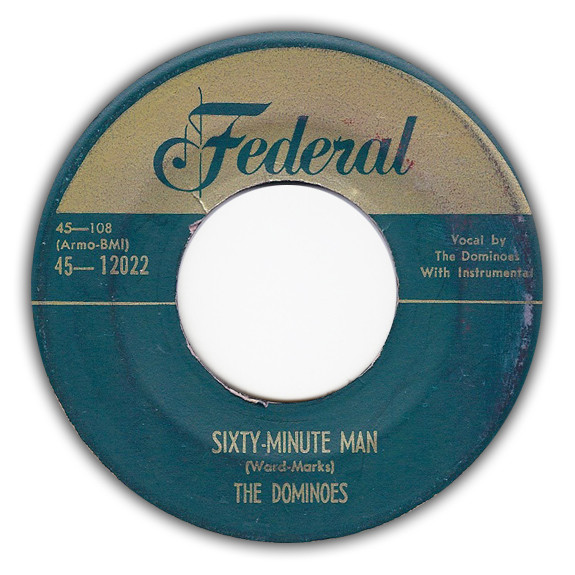
Released as their fourth single in March of 1951, “Sixty Minute Man” sounded like nothing else at the time, and even by the end of the decade still sounded contemporary. For one thing, such explicitly sexual lyrics had only been heard on blues records — never by a pop vocal group. And they were outrageous for 1951. More importantly, although to “rock” someone or “roll” someone had been heard before on blues records, their appearance in the lyrics to “Sixty Minute Man” may have led to DJ Alan Freed coining the phrase “Rock and Roll,” and it certainly makes a strong case for the song being among the first in the genre.
The single topped the R&B chart but also, in what was still an unusual occurrence for the time, crossed over to the all-encompassing pop Top 20. And it did this despite being frequently banned by radio stations who found it vulgar and lowbrow. Little did they know that “Sixty Minute Man” was the product of a Julliard-trained musician.
So rock ’em, roll ’em, all night long … with The Dominoes.
 1 2 3 o' clock 4 o' clock Rock
(laughing).
😂