If at first you don’t succeed in the music biz, you can do the old “try try again” OR you can hit the reset button, blow it all up, and start rebuilding your dream from scratch. Reinvention has its risks, but there’s truth in the saying from old: fortune favors the bold.
The Paramounts formed in Southend-On-Sea, Essex, England in 1960. Pianist Gary Brooker, guitarist Robin Trower, bassist Chris Copping, and drummer B.J. Wilson were barely in their teens but all had spent years with various bands around town. The group began by playing straight ahead rock & roll but soon adopted a heavy soul and R&B sound, emulating Ray Charles and James Brown.
Within a few years, The Paramounts found themselves frequently opening for The Rolling Stones (Keith Richards called them the best band in the UK) and releasing singles on Parlophone (their producer worked with both The Beatles and The Hollies). Sounds like they’re just a step away from stardom. Everything’s coming up Paramounts, right?

Unfortunately, Parlophone tried to steer The Paramounts in a pop direction on their studio recordings which led to a disconnect with the music. Coupled with the fact that the band didn’t have much in the way of original material at a time when original material was coming into vogue meant that their singles didn’t hit, and in 1966, weary of the grind, The Paramounts broke up.
Brooker decided to give up performing entirely and instead focused on songwriting, an endeavor he embarked upon with a lyricist he had recently met named Keith Reid. During the summer of 1966, the two attended a swingin’ London party with all attendees under the hazy influence of grooviness. At one point toward the end of the night the host remarked to his wife that she had turned a whiter shade of pale and should perhaps head off to bed. Reid took the line and wrote fantastical lyrics about a trippy late-night party; Brooker then set the words to music (with a nod to Percy Sledge’s “When A Man Loves A Woman” and a little Bach for good measure).
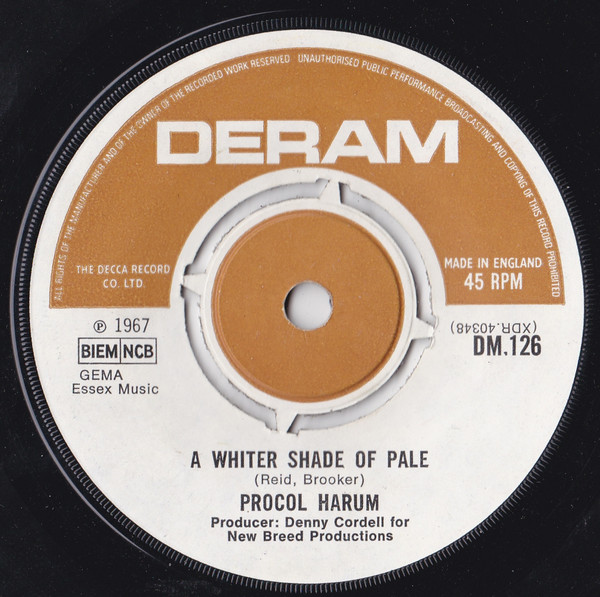
By early 1967 the songwriting duo hadn’t found any takers for their musical efforts so they decided to go ahead and start up a band themselves. The times they were a’ changing so Brooker and Reid avoided standard monikers and took the name of a friend’s cat, Procol Harum. They recorded a demo of their party song, titled “A Whiter Shade Of Pale,” and after a few rejections, finally found producer Denny Cordell to take them into Olympic Studios for a finished recording. Organist Matthew Fisher joined the band along with a couple of hired musicians on guitar and drums, and the recording was completed in only two takes with no additional recording or overdubs.
Two takes.
Released as a single in May of 1967, “A Whiter Shade Of Pale” quickly cartwheeled its way to #1 on the UK charts where it ensconced itself for six weeks. In order to take advantage of their newfound popularity, Procol Harum needed to tour and record an album, but they still didn’t have a permanent guitarist or a drummer. They did happen to know a couple, though.

Brooker decided to get the old band back together again and called up Robin Trower and B.J. Wilson. It took breaking up and completely revamping their sound, but The Paramounts were back. Well, most of them. Procol Harum’s bassist was a newcomer, but when he left after their third album, the first call was to former Paramounts’ bassist Chris Copping, who joined up immediately.
Until their dissolution in 1977, the only song the group ever recorded without at least three members of the original band from 1960 was their first and biggest hit, “A Whiter Shade Of Pale.”
So skip the light fandango … with Procol Harum.
 1 2 3 o' clock 4 o' clock Rock
I love this song. It throws me right back into those years of political upheaval, and sparkling mirror globes from the ceiling as, once young, we could dance all night and into the day, and never feel tired. It is a brilliant song.
And what a wonderful weekend with your mother, dad, and sister. One day, we’ll meet also.
This song is brilliant. And still sounds marvelous! I never stayed up til the wee hours dancing to it but I certainly remember doing that with other music back in the day. Amazing the resiliency of youth.
I’m delighted to hear you had a good time with my family. We’ll be back on your shores soon!
And I’m in Bogotá for Christmas and New Year. 🤗
Bogotá, England? 😉