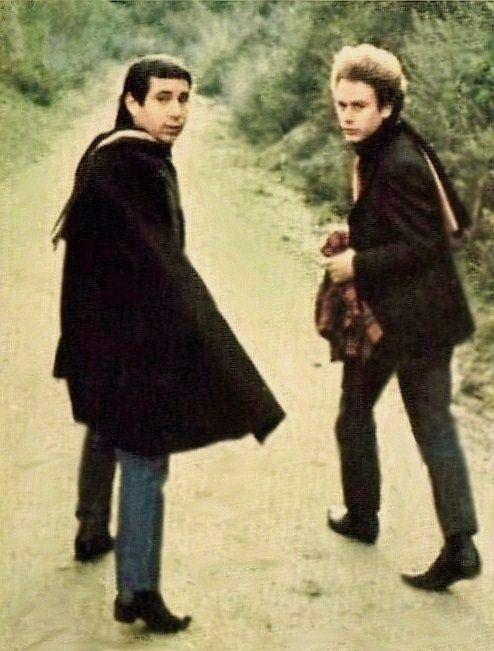
The literary side of folk-rock.
Paul Simon and Art Garfunkel weren’t brothers, but they may as well have been. They sang together beautifully and fought together often, just like so many siblings throughout rock’s history. Which isn’t too surprising considering they met in elementary school in New York and were joined at the hip for nearly two decades. Alas, the brotherly love did not last.
The pair initially bonded over a shared love of doo-wop and early rock & roll, particularly The Everly Brothers. At the age of 15, Paul and Artie took their own money and went into a small Manhattan studio to record a song they’d written called “Hey, Schoolgirl.” Just like a rock & roll fairy tale, a promoter happened to hear them and signed the guys to his indie label, after which they decided on the nom-de-cartoon, Tom & Jerry.

“Hey, Schoolgirl” ended up selling 100,00 copies, hit the Billboard chart, and Paul and Art appeared on the most popular music program of the day, American Bandstand. Further hits proved elusive, and Tom & Jerry dissolved when each went to college in NYC.
Although they attended different schools, the music kept them together. Unsurprisingly for two smart college kids hanging out and absorbing the scene in hip and happening Greenwich Village, Simon & Garfunkel reinvented themselves as folkies in 1963 and were quickly signed by Columbia Records.

Their first record sold next to nothing and the duo split up again, Simon moving to England to record a solo album and Garfunkel returning to school. But in the meantime, their producer, Tom Wilson, inspired by the fast-rising popularity of folk-rock, took one of their songs titled “The Sounds Of Silence” and used session musicians to beef it up with electric guitar, bass and drums. Result? #1 hit. Paul initially hated what Wilson did to the song, but that didn’t last long.
Simon & Garfunkel reunited (not for the first time, and certainly not for the last) and the music they subsequently created helped define the second half of the 60s, paving the way for the singer-songwriter movement of the early 70s.
Hello darkness, my old friend. Ain’t you got no rhymes for me? Here’s the least you need to know:

Parsley, Sage, Rosemary and Thyme (1966) The apogee of their folk-rock output. Bouncing between New York and California. Filled with sunshine, rain, and clouds; leaves, trees, and flowers. Deep forest greens and big bright greens. Pastoral pleasures.
Bookends (1968) An album of not knowing. What it means to be young, to be old. Searching for America when America isn’t where you left it a few years ago. Fakin’ it until you can find out.
Bridge Over Troubled Water (1970) A goodbye to the 1960s. And a farewell to the partnership of Simon & Garfunkel. A foreshadowing of Simon’s future musical path.
Simon & Garfunkel only recorded five albums and they’re all fairly short, so you could just throw in the first two. The debut is straightforward, though well-performed, folk; the second is a bit of a hodge-podge as it was hastily recorded, but it does contain a few of the duo’s classics, like “The Sounds Of Silence,” which, of course, is a song that must be included in the least you need to know.
 1 2 3 o' clock 4 o' clock Rock
I love these two. They were brilliant, and so are their songs. I still listen to their music on a regular basis.
Me, too! My mother had a few of their albums and The Graduate is one of my favorite movies (perfectly soundtracked by Simon & Garfunkel) so I’ve been listening since I was a kid. It’s been fun for me to spend the last week with them.