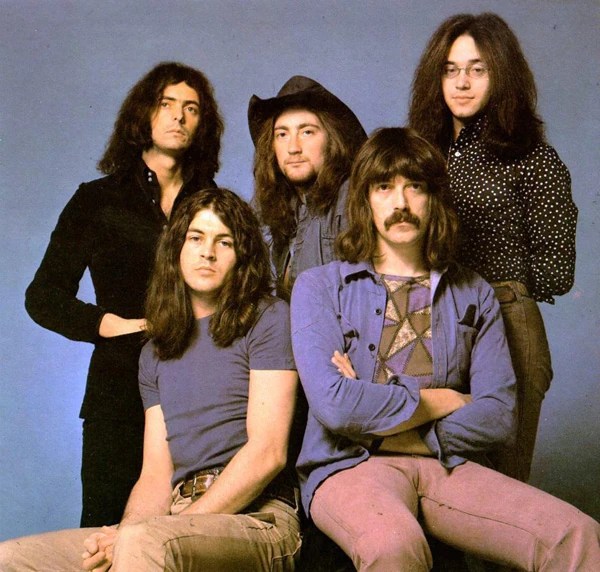
Like rolling thunder in the velvet night, with slabalicious strikes of crackling electricity. Thus rocks the Deep Purple.
The band who would become Deep Purple took their first tentative steps in London in 1968 when four musicians from a number of talented second and third-tier bands with varying degrees of success decided to form a new group called Roundabout. They drafted an unknown singer (and eventually a different drummer) and a new rock band was born, based on a desire to combine the guitar gymnastics of Jimi Hendrix and the heavy sludge of Vanilla Fudge ….. at maximum volume.
They soon switched to the name Deep Purple since it was the favorite song of guitarist Ritchie Blackmore’s grandmother, and the band found immediate success in America with their covers of “Hush” and “Kentucky Woman.” Alas, they couldn’t get arrested in the UK. Blackmore and organist Jon Lord wanted their sound to be harder, louder, faster, and that meant replacing singer Rod Evans with leather-throated banshee belter Ian Gillan.
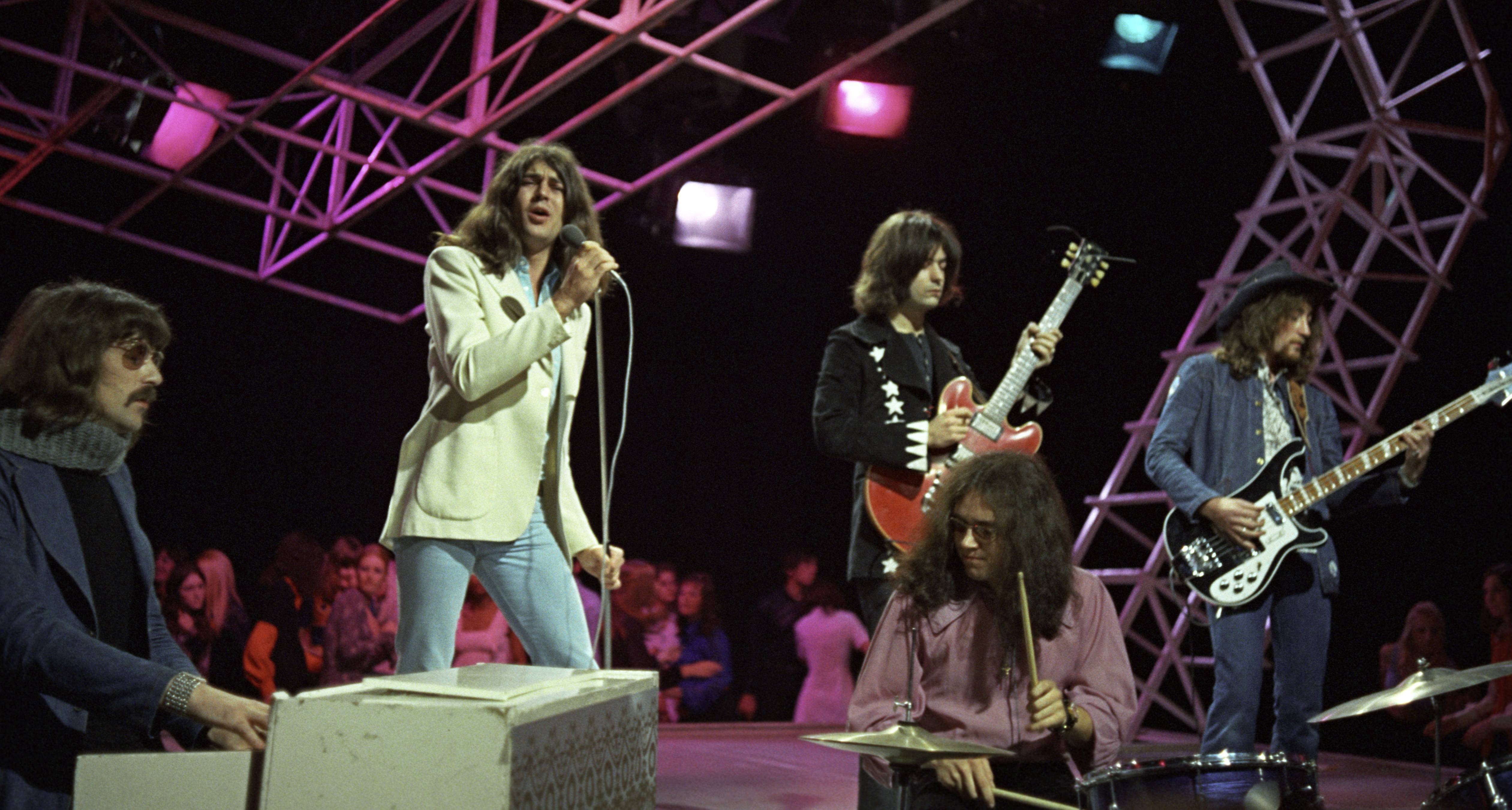
And so it came to pass, Deep Purple’s classic Mark II lineup bestrode the Earth (each incarnation would be denoted as such; the current configuration is known as Mark IX). Soon they were on par with Zeppelin and The Who as the loudest, most raucous rock bands on the planet. They didn’t know it yet — thinking of themselves as a modern version of a 50s rock & roll band — but they were helping to plant the seeds from which the mammoth tree of heavy metal would grow.
Smoke on the water. Fire in the sky. Here’s the least you need to know:
Deep Purple In Rock (1970) A keening wail in the night. Something mysterious takes flight. Are Blackmore’s guitar and Lord’s organ battling the darkness? Or inviting it?

Machine Head (1972) Taste the metal. Speedy guitars, galloping guitars, harmonized guitars. A rock & roll band writes the future. Riff around the clock. Space boogie.
Made In Japan (1972) Does exactly what a live album should — treats the studio versions like an opening act and tries to blow them off the stage. The guitar as velocity. The band as a machine made of muscle and blood.
You must also know “Hush,” their debut single, still in heavy rotation on classic rock radio today, and “Black Night,” a non-album single from 1970 and their biggest UK hit. Those are all the basics, but if your music geek specialty leans toward hard rock and heavy metal then you need to add three more albums: 1969’s Deep Purple (Mark I), 1971’s Fireball (Mark II), and 1974’s Burn (Mark III).
 1 2 3 o' clock 4 o' clock Rock
I was a little Rocker at exactly THAT time, with early Led Zep, Black Sabbath, Humble Pie, Johnny Winter and Deep Purple making sure that my neighbors didn’t get much sleep. Mom learned that the phrase “Turn down that noise!” didn’t buy anyone a single decibel of peace and quiet. And looking back, I realized that of all those bands (Any many others from that “reach for the Excedrin”era), Deep Purple was the band that really never left my turntable for more than a moment or two, specifically the three albums referenced in this article. Sonic destruction can call to mind such sweet memories.
Thanks for the comment! I’ve written about 3 of the artists you mentioned and Humble Pie and Johnny Winter will be addressed at some point. It’s always great to hear from people when I write about one of their favorite artists. Hopefully, I did justice to Deep Purple and their “sonic destruction.” Thanks again!