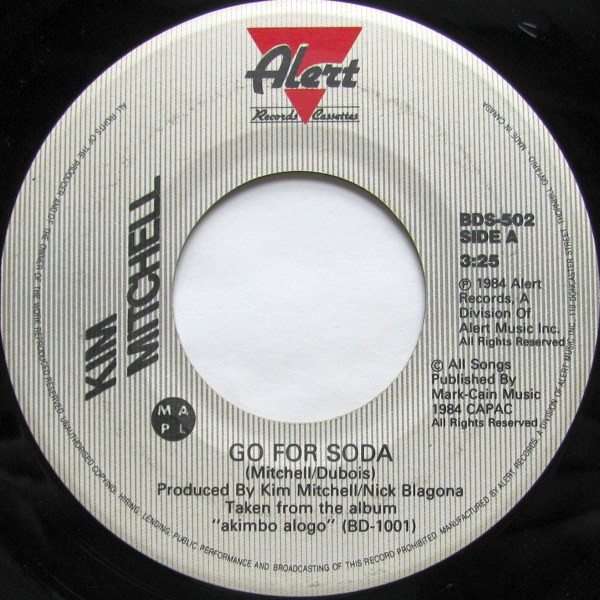
Various entities co-opt songs all the time, hoping to promote their cause by associating it with a song whose lyrics seemingly fall into line with their stated ideals, whether or not that was the original intention of the songwriter. (That’s why we hear of countless cease and desist orders during election cycles — artists are protective of who they’re associated with.) But occasionally, the artist is all for it, even if the link between the lyric and the cause is completely unintentional.
Canadian Kim Mitchell began his musical career in the early 1970s as the lead singer and guitarist for Max Webster, a band who played a difficult to pigeonhole mix of rock, pop, prog, and whatnot. They never scored any major hits in their homeland, but their albums sold well and the band became a popular live draw (they were headlining concerts by the late 70s, but they also opened for Rush over 200 times, as well as every other popular rock artist of the day).

The band seemed to shed a member after each album they completed until eventually it was was just Mitchell and the drummer. In 1981, Mitchell figured it was time to go solo. He and his longtime songwriting partner, Pye Dubois, stuck together, and after an EP to test the waters, got to work on a full-length solo debut, 1984’s Akimbo Alogo.
At a party one night, Dubois handed Mitchell a napkin with lyrics written on it: “might as well go for a soda, nobody hurts and nobody cries, nobody drowns and nobody dies.” Mitchell expressed his enthusiasm but Dubois, somewhat dismissively, said he could endlessly churn out lines like this, and proceeded to do so in the middle of this party.
Mitchell had a rhythm riff he’d recently been playing on the guitar and when he played it at home the next day found that the soda verse fit perfectly. Dubois completed the lyrics, centered around an arguing couple, with the narrator suggesting they cool off and go for a soda rather than letting the fight escalate — with possibly dire consequences. Released as a single in 1984, “Go For Soda” not only became Mitchell’s biggest Canadian chart hit up to that point, but also cracked the US charts (#86 on the Hot 100, but #12 on the Rock chart).
Shortly afterwards, the American group M.A.D.D. (Mothers Against Drunk Driving) contacted Mitchell to ask if they could use his song in their upcoming commercials. The lyrics in the chorus sounded as if they were tailor-made for an anti-drunk driving campaign. Of course, they were not at all intended that way, but Mitchell was more than happy to allow use of the song for such a good cause.
 1 2 3 o' clock 4 o' clock Rock