Mystery!
True crime has always been a popular genre, from ancient murder ballads passed on from singer to singer to cheap broadside news stories hawked on the street for a penny, from Truman Capote’s In Cold Blood in the 1960s to Movies Of The Week torn from the headlines in the 1980s, right up to today’s deluge of grisly podcasts and grislier Netflix mini-series.
The music business has its own share of crime stories. It isn’t all fun and games, rock & roll parties and bubblegum pop. And although they’re certainly more common, the crimes committed aren’t always on a business or monetary level. There are dark actions to be found behind the scenes.
Bobby Fuller grew up in West Texas in the 1950s. And, like every kid who grew up in West Texas in the 1950s, worshipped at the feet of Buddy Holly and The Crickets. Fuller showed an early aptitude for music, able to pick up almost any instrument and master it quickly, but playing in the school band proved far less exciting than the rock & roll sweeping the nation and he began forming his own groups, usually with his brother Randy on bass.

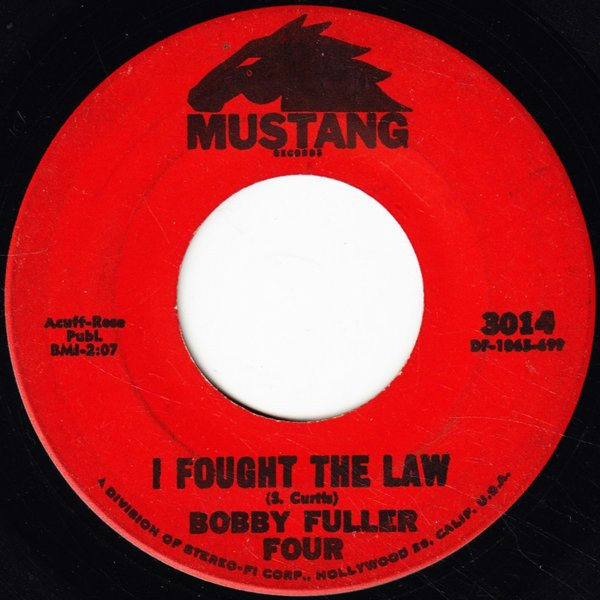
The band that eventually became the Bobby Fuller Four solidified around 1962, but still played under a variety of names, including The Fanatics and The Shindigs. Like his idol, Fuller wrote his own songs to mix in with covers, and one of the covers the band played was suggested by his brother, a song called “I Fought The Law,” released by the post-Holly Crickets in 1960. Bobby’s group recorded their own version at his home studio and it became a regional hit.
The band gained popularity in the Southwest through their energetic live shows and self-released singles, but eventually they decided to try out for the big time and moved to Los Angeles in 1964.
They had tried L.A. the year before, shopping their music to every label in the city, but the only person who expressed interest was Bob Keene from Del-Fi Records (the guy who signed Ritchie Valens back in the 50s). Keene told them they weren’t quite ready for prime time and to come back in a year. So they left, and they came back, and Keene signed them to Del Fi, even giving the band their own imprint, called Mustang. They played residencies at a few different clubs in the city and quickly became a very popular live attraction.
Now known as The Bobby Fuller Four (as Bobby was the driving force behind the music), the group scored a hit on local radio stations in the summer of 1965 with the Fuller-penned “Let Her Dance,” but distribution trouble with another label caused the song to disappear prematurely. They didn’t have time to dwell on that disappointment, however, because in October they released a rerecorded version of “I Fought The Law.” There was no trouble this time. The single was a smash and peaked at #9 in March of 1966.

Bobby Fuller was found dead four months later. He was only 23.
His body was discovered behind the wheel of his mother’s car in the parking lot of his apartment building. He hadn’t been seen since 1:00 AM the previous night when he’d taken the car to go meet someone, and he’d missed an important band meeting that morning — a meeting whose agenda included ending the relationship with Bob Keene of Del-Fi due to mismanagement.
The coroner initially ruled his death a suicide (though it was later changed to “accidental death”), but virtually everybody who knew him suspected foul play. Fuller appeared to have been beaten and there was a full can of gasoline on the floor of the car. He supposedly died of asphyxiation from inhaling the fumes, but nobody could explain why the full can was there or how Bobby got covered in gas. His mother had been checking the apartment parking lot repeatedly all day to see if he’d returned, so the car couldn’t have been there for long, but it seemed like Fuller had been dead for quite a while.
One theory put forth involves Morris Levy, the notorious owner of Roulette Records in New York. A number of artists who argued with him about royalties or publishing rights wound up dead — or severely injured — very soon afterwards, and none from natural causes. He retained an enforcer and that enforcer was not reticent about what he did for a living. Supposedly Fuller had dealings with Levy during a visit to New York and there’s a witness who swears they saw an unreleased promo single of “Let Her Dance” with a Roulette label. If Fuller backed out of a deal with Levy, Levy’s retort would not be subtle.
Of course, it could have been an accident. Or manslaughter. Or suicide (however unlikely). Due to the coroner’s report, the police never investigated and no further evidence has come to light. Sixty years have passed and the mystery will likely never be solved.
But the enduring legacy of Bobby Fuller will always be 2 minutes and 17 seconds of pure rock & roll.
So break some rocks in the hot sun… with The Bobby Fuller Four.
On a personal note, I remember hearing “I Fought The Law” on the radio as a young kid living in Oklahoma. It’s been a favorite of mine ever since, not only because it’s a great song, but because it has one of my favorite musical touches in pop history. During the lyric about robbing people with a six-gun, the drummer breaks the established rhythm and cracks the snare six times. As a child, that blew my mind — it was the first time I realized you could do that, accent the music to emphasize the lyric.
Bobby Fuller taught me something I’ve never forgotten.
 1 2 3 o' clock 4 o' clock Rock
Wow I had no idea he died under such mysterious circumstances. I Fought the Law and Let Het Dance are both killer songs!
Drake
It’s the kind of thing I vaguely knew but for some reason could never remember. I’d sometimes hear I Fought The Law and think, Why Didn’t Bobby Fuller do anything after this? Then I’d look it up and think, Oh right. By all accounts he was a great guy and extremely gifted musically. It’s a sad story.
Ah, thank you long-term memory for complete lyrics recall. And until you mentioned it, I hadn’t noticed that rap-rap-rap-rap-rap-rap of the drum, I mean I noticed it before but not its relevance to the lyrics. Excellent article, Houston.