Being young and naive is okay when you’re a toddler, but after that you better wise up quick, Jack! This is the real world, and the real world wants to stuff you in a locker and steal your lunch money.
And if you plan on going into the arts you better hone those real world smarts, chum. Ocean-based sharks may seem scary but will generally ignore you — rock & roll sharks, on the other hand, will eat you alive. And Mommy won’t be there to read the fine print and kiss your boo-boo all better.
Welcome to Rock-A-Teens!
Rich and famous? Nope.
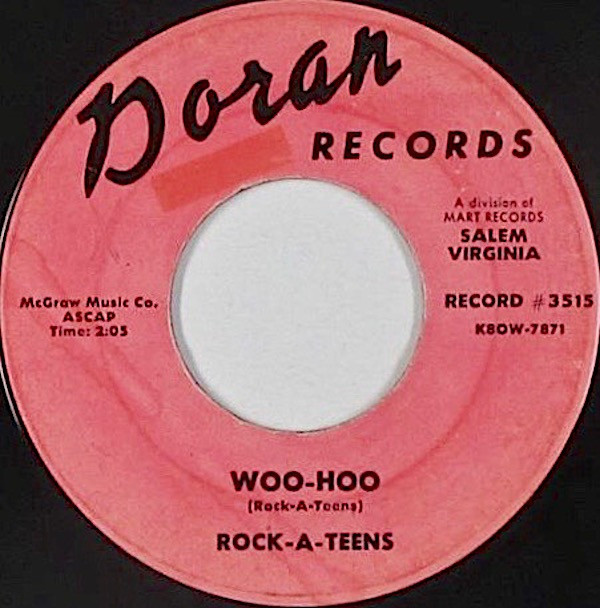
Rock-A-Teens first met and made music in 1956 as high schoolers in Virginia. They stuck together, and in 1959 one of their songs, “Rock-A-Teen Boogie,” a mostly instrumental number the band cooked up themselves, gained the attention of local music impresario George McGraw. He owned a small indie label and decided to retitle the song under the new name “Woo-Hoo” and release it as a regional single.
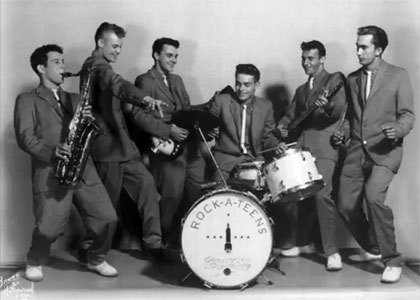
Everything seemed promising for the boys, until they learned that guitarist Arthur Smith, writer of a hit song from 1948 called “Guitar Boogie,” planned to sue them for copyright infringement. Rock-A-Teens were shocked by the accusation (as well they should have been since the charge was patently flimsy — you can’t copyright chord progressions, or a style, such as boogie woogie), but the head of their label, George McGraw, offered to help.
Surely he has their best interests at heart.
McGraw bought “Woo-Hoo” from the group for a few hundred dollars, insisting this would protect them from any lawsuits. Little did the kids know that McGraw had struck a deal with Morris Levy — head of Roulette Records and infamous, mob-connected scumbag — to distribute the record nationally. The single went on to peak at #16 on the US chart in the fall of 1959.
The kicker? McGraw owned the song now and he changed the writing credit from Rock-A-Teens to his own name, which meant he received all the publishing royalties. He wasn’t sued by Arthur Smith and he profited greatly from the Top 20 hit (and continued to profit since presumably he made money when the song was covered by the 5.6.7.8’s for Quentin Tarantino’s Kill Bill Vol. 1).
Rock-A-Teens recorded a full-length album for release in 1960 but rock & roll was entering a much less raucous period as clean-cut, teen heartthrobs like Fabian and Frankie Avalon began to take over bedroom walls.
But if you like your music exuberant and unpolished — and want to hear what is possibly the first non-jazz drum solo — then let’s go back to 1959: young, naive, and ready to rock.

